 |
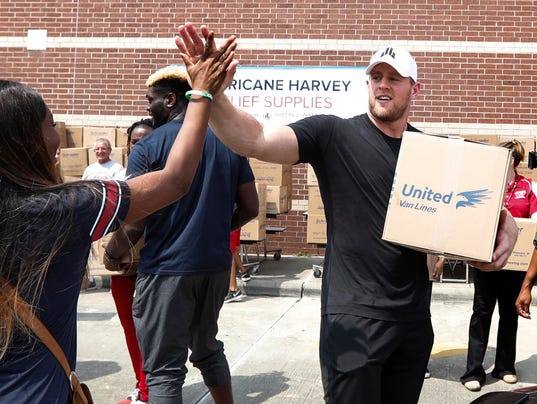
| J.J. Watt handing out supplies - Credit: USA Today |
The last time a major hurricane (category three or higher) made landfall in the United States was all the way back in 2005 when hurricanes Dennis, Wilma, Katrina, and Rita all caused extensive damage to Florida and Louisiana. It has been a record setting 12-year break before the next major hurricane made landfall in the United States: Hurricane Harvey, just three weeks ago.
 |
| The extent of the flooding in Houston Credit: Tri-State Weather |
Any time that a natural disaster of this magnitude occurs, it is vital that others provide assistance to those impacted and help them to restore their lives back to normal. Often times you'll see national news stations give information as to how people can donate money to the Red Cross or other organizations that will provide aid for the victims of the natural disaster.
 |
| Houston Texans' J.J. Watt Credit: Wikimedia Commons |
J.J. Watt started a crowdfunding campaign on youcaring.com shortly after Hurricane Harvey devastated the coast of Texas, and its monetary amount and popularity grew exponentially. Famous actors and well-known athletes contributed to Watt's relief fund, helping to bring its total-to-date to over $32 million, obliterating Watt's initial goal of $200,000. To no surprise, Watt's relief fund is now the fastest growing, largest crowdfunding charitable fundraiser in the ten-year history of crowdfunding.
Therefore, I am selecting J.J. Watt's Hurricane Harvey relief fund as my artifact, and I would most likely use some of the above facts and talking points to form a hook for my speech. Some talking points that might emerge in my speech could be how J.J. Watt made this crowdfunding campaign go viral and why so many people gave money to this relief fund.

These talking points will allow me to discuss how J.J. Watt used the principles of rhetoric to convince famous athletes, celebrities, and the entire United States population to donate to his relief fund. These points will also allow me to talk about how Watt's crowdfunding campaign invited the general public to be civic and help those impacted by Hurricane Harvey by donating money.
I believe that this artifact will allow me to develop a well-crafted speech that will be engaging for the audience to listen to.


This is a very intriguing artifact to choose, being that we are in the midst of the damages of this hurricane today. It draws attention to the audience regardless of any hook because the topic itself is a hook. This is something that hits very close to home for all of us, and most definitely lays out an opportunity for us to be civic and play a role in hurricane relief to support those desperate for it. As for your points, discussing the principles of rhetoric used in order to lure donations is new and refreshing and I believe it should be your strongest point! Good luck and I cannot wait to hear all about it! :)
ReplyDeleteNice medium. Although I do believe that there may be some difficulties in analyzing the various rhetorical strategies that are present in such a campaign as it is not as solid as a speech or a single piece of ad. I do think that with a little bit of integration and analytical ingenuity, you can pull this off quite well.
ReplyDeleteI love it! Also, I am very impressed with your blogs layout, it is very good looking. My only critique is that I think you should work with a more specific aspect of Watt's relief fund instead of the fund as a whole. I think it would be helpful iif you found the original wording that he used to create support for the hurricane relief. This would make it easier to include rhetorical terms and it would show exactly how Watt called his audience to engage in their civic duty.
ReplyDeleteJacob, your selected artifact is timely! Nice choice. I think you're on the right track, so let me offer just one brief tip:
ReplyDeleteIn the next assignment (the rhetorical analysis essay), you'll be prompted to analyze the rhetorical features of your pieces, so you'll be looking specifically about what types of appeal(s) it used to persuade its audience to act.
In the speech, however, your goal is primarily to analyze how/why the artifact is civic, and to tease out those civic commonplaces and ideologies working within it. That being said, for the speech, I wouldn't delve too deeply in, say, a discussion of "ethos," because this is more about a rhetorical appeal at work through Watt's character, but perhaps rather frame the point as how Watt, as a famous athlete, had a platform to draw our "structures of attention" to the cause in a larger way that perhaps an ordinary citizen would be able to do.
It's just a hypothetical example, but does that distinction make sense?
Hope that helps!
Just to make sure that I'm clear, the speech portion will only discuss how the artifact was civic and then the essay will discuss how the artifact uses rhetoric.
DeleteSo I should not talk about how J.J. Watt used the principles of rhetoric to convince others to contribute to his relief fund in my speech? I should save this for my essay?
I should only talk about how the campaign invited the general public to be civic and the ways that the fund was civic?
I think this artifact is a really interesting choice! The amount of money Watt was able to raise is truly incredible, and there is a lot that goes into campaigning in order to raise that much. That being said, I'm sure you will have no problem finding great rhetorical examples for your speech.
ReplyDelete