Wednesday, November 15, 2017

Why I Both Love and Hate Technology - A TED Talk Story


Imagine spending countless hours over a few days leading up to your presentation constantly practicing your TED Talk over and over so that you know every last word inside and out. Then, when you finally get up in front of the class, the bright lights are shining on you, and the camera is rolling, you go to advance to your next slide and....nothing. But then suddenly your PowerPoint skips randomly through the next couple of slides, revealing what you'll talk about next.

A little sense of panic sets in as you quickly try to flip back to the slide you want to be on. You're thinking to yourself, "why does this only happen to me and not anyone else?" I don't know if it was something that I was doing wrong when I pressed the button on the clicker or if technology is to blame, but this technological malfunction was one of the few mishaps of my TED Talk.

Going through my preparation process for my TED Talk, I took the route of memorizing my talk that is outlined in Chris Anderson's article "How to Give a Killer Presentation." He states that many of the best and most successful TED Talks have been memorized word for word, and he goes on to say that this is the best way to go if you have the time to do this.

I probably didn't have the time to do this, but I took on this daunting task anyways, probably driving my dorm room neighbors insane from the number of times that I repeated a sentence over and over again until I had it memorized. I did not want to be stuck in the dreaded "valley of awkwardness" that Anderson touches on as well, which is where a person hasn't quite memorized their talk yet so it would be easy for the audience to sense this. I was able to get past this point by continuing to practice even when I thought I was all done, and even recording myself on my phone and listening back to it.

I'm fortunate enough to have had the opportunity to talk in a "high pressure situation" before with the Penn State Campus Weather Service this semester where we produce video forecasts in front of a green screen and professional cameras and equipment (for those that are curious, here's links to my videos: 11/2/17 and 9/7/17). Doing a couple of these video forecasts throughout the semester has helped me to improve on my public speaking skills as well, and a big thing that I've learned is to have confidence when you're talking. With the forecasting videos, we only have about an hour to put together our graphics and record our video, so we obviously don't have enough time to come up with and memorize a script. Therefore, the majority of what we say in front of the camera is off-the-cuff, so confidence helps out a lot. Even though my TED Talk wasn't impromptu, possessing the confidence that you "own" the content that you're talking about really helps to convey your message to the audience.

Looking back on my TED Talk preparation, I probably could have started practicing a little bit earlier to give myself some more time to memorize the script and visit the Undergraduate Speaking Center to practice. Rehearsing my talk in my dorm room was fine, but I didn't have the full set up with a clicker and my PowerPoint behind me. Therefore, I feel like visiting a place like the Speaking Center would have been helpful in preparing even more for my TED Talk.

When it came down to my actual TED Talk, I think that I did a pretty good job of conveying my information and ideas to the audience and I was happy with my performance. I spent a lot of time working on the PowerPoint and the visuals to make sure that they would complement what I was saying and that they would help the audience understand what I was trying to tell them. I felt that going in chronological order with my paradigm shift and pointing out the year markers helped with the progression of my talk, before I came to the significance of the shift at the end of the speech. I also thought that my eye contact was really good, since I tried to look at every audience member, and I think I improved on my volume, in terms of not being too loud, from the last speech that I gave. The use of gestures was something that I did well in my TED Talk as well, I believe, helping me to not look as stiff and to make some of my points be emphasized or made clearer.

The components of the presentation that I would most like to improve would be my tone and my articulation. Although I think I've improved on these aspects of my speaking since my first speech, I still feel like some of my words at the end of my sentences aren't articulated clearly enough and I still have a pretty monotone voice. I tried to integrate a little humor and opportunities for me to vary my tone of voice in the beginning of my TED Talk, but as the talk progressed I feel like I fell back to being monotone for the most part. However, overall, I was very pleased with how my TED Talk went and enjoyed studying the paradigm shift of weather forecasting.

Wednesday, October 18, 2017

How the Sports World Hit a Home Run and Forever Changed the Way We Watch Sports

Photo Credit: Curved View
Imagine not being able to watch your favorite sports team play every day. Not being able to see your favorite player catch an amazing touchdown pass or hit a walk-off home run. Unable to watch the Super Bowl, which has been the most popular television broadcast year after year, with all of your family and friends. Disconnected from the sports world that you've become so attached to.

Less than a century ago, this is what people had to deal with. Back then, of course, sports weren't as prevalent in society as they are today, with fewer teams for each sport and some of the present day sports not even invented yet or not yet reaching their present day format. But in order for those Americans to know what was happening with their favorite team or player back in the 1920's and 1930's, they needed to tune into a radio or get information about the game telegraphed to them or someone they knew. 

The first televised sporting event was a college basketball game between Columbia and Princeton in 1939. NFL games were first shown on television beginning in 1939 and NHL games shortly after in 1940. People now had the television to touch bases on how their favorite team was doing and they were able to see what was happening during a game from the comfort of their own homes. 

What really revolutionized the broadcasting of sporting events was the debut of ESPN in 1979. A cable channel dedicated solely to sports was created, earning the distinction of the "Worldwide Leader in Sports." Now fans would knew exactly where to go to get their sports news and headlines, distinguishing ESPN as a cornerstone of any sports fan for the years to come. 

Photo Credit: Gunaxin Gadgets
The advent of the internet and social media also impacted the way people watch sports and get sports news. Scores and video highlights could now be looked up online, without actually having to watch the game live to understand what happened. Events and news were also posted on social media the instant they happened, keeping viewers and fans very much connected to what was actually happening in the game through social media. The other big innovation was the ability to stream live games on your laptop or mobile smartphones, allowing you to bring live sports coverage anywhere you went. 

Therefore, my thesis would be similar to this: Advances in technologies throughout the 20th century, especially changing the way people watch television, drastically impacted the way people watched sports from having to watch games in black and white on a small television set to being able to watch live sporting events from devices that fit in your pockets, demonstrating a significant shift in the way that Americans watch sports.

For my essay and TED Talk, I would be focusing mainly on the time period from 1939 until today to demonstrate the clear and well-defined differences between watching sports in these different eras. I would use some of the points that I mentioned previously in this blog post, but I would also describe how watching sports has impacted our society and our culture over time as sports have become more and more involved in our daily lives. I would also talk about the future of sports broadcasting and some exiting new technologies that will further alter the way we watch sports.

Here are some of my preliminary sources: 
"History of Sports Broadcasting." Be on Air Network, Miami, Ohio, Illinois and Colorado Media
     Schools, beonair.com/history-of-sports-broadcasting/. Accessed 19 Oct. 2017.
"How Technology Has Changed the Way We Watch Sports." NGCIT, 19 Nov. 2015, ncgit.com/
     how-technology-has-changed-the-way-we-watch-sports/. Accessed 19 Oct. 2017.
Ozanian, Mike. "Virtual Reality Will Be a Paradigm Shift for Sports Viewing." Forbes, Forbes
    Media, 25 Nov. 2015, Virtual Reality Will Be A Paradigm Shift For Sports Viewing.     
    Accessed 19 Oct. 2017.
Tubbs, William. "How Technology Has Changed the Way We Watch Sports." Innovation
     Enterprise, channels.theinnovationenterprise.com/articles/how-technology-has-
     changed-the-way-we-watch-sport. Accessed 19 Oct. 2017.
Weintraub, Robert. "The Future of Sports Television." Slate, Slate Group, 31 Oct. 2008,
     www.slate.com/articles/sports/sports_nut/2008/10/the_future_of_sports_television.html.   
     Accessed 19 Oct. 2017.

Wednesday, October 11, 2017

Our Ever-Changing Views on Climate Change and Communicating Information

Photo Credit: Pixabay

Climate change deserves the spotlight right now.

It's worked its way to the forefront of political debate, it's becoming increasingly prevalent in our daily conversations, and our views on the topic of climate change have changed drastically over the past 100 years.

Photo Credit: NASA Global Climate Change
The first option for a paradigm shift that I would like to study for this unit is how our view of climate change has changed over time. When the industrial revolution began in the late 1700s and early 1800s, no one cared what these new machines that people were inventing released into the atmosphere. No one at the time had the scientific knowledge or the foresight to realize that the machines that were being created would immensely alter our climate in the years to come.

These fossil fuel burning devices and activities, such as the internal combustion engine and the increase in the use of coal as a source of power, spread quickly throughout our society. Our economy and our infrastructure were built off of fossil fuels, and many of the remnants from this system linger today. But there's been a noticeable shift in the way people view the way we're treating our environment. Now there's an increasing amount of scientific evidence to prove that humans are contributing to global warming and directly impacting the amount of carbon dioxide in our atmosphere. This has led to and will continue to lead to negative consequences for our planet moving forward. Therefore, a large majority of scientists and people have shifted their views to support the fact that we need to cut down on our greenhouse gas emissions in order to ensure the sustainability of our planet.

Photo Credit: WikiMedia Commons
A second paradigm shift that I would consider studying for this unit would be how we have changed the way we receive information. Not too long ago, people used to eagerly await for the newspaper to arrive at their doorstep so that they could read the news that day. People would also tune into the radio in their homes for the latest news updates. But, in today's society, we hardly look anywhere else besides our smartphones for information throughout the day. All the news we could ever want is instantaneous and at our fingertips.

Photo Credit: The Telegraph
This drastically changes the way that media and companies communicate information to the general public. Now, their messages must be communicated through different means than through which they were communicated 50 years ago. Social media and websites have now become the main sources for information. And there's not only changes in the medium that we receive information through but also changes in how much information we receive. We now receive five times as much information every day as we did in 1986. I think it would be interesting to explore how this influx of information has both positively and negatively impacted our daily lives.

Wednesday, October 4, 2017

What's Your Story? The Secret Behind Crafting a Great Speech

Photo Credit: Adore to Empower
How will you be remembered? 

It's the question we often find ourselves pondering: what will my legacy be when I'm no longer around? What will others recall about my character and my actions?

Similarly, it's imperative that we use this same approach when crafting speeches, and some of the best talks that I've heard were the ones that I still remember to this day.

How did the authors of these amazing talks make their speeches so memorable?

People quickly become inundated by messages and speeches, whatever form they might be in, on a daily basis. The best speeches are the ones that stick with us and stand out in the clutter of all of these words and information. I believe that the best, and simplest, way to make a speech be remembered by the audience is by telling a story that provides a real-life example of the speaker's message. Using anecdotes engages the audience in a way that a slideshow or statistics cannot do - the listeners can clearly see how the message of the talk can be applied to their own, personal lives. And when an audience is engaged, for instance by being able to easily connect what is being said by the speaker to their everyday lives, they are more likely to retain the information being presented and remember the speech in the future.

Stories help us remember the key points of a talk because they give us a connection to our everyday lives, so whenever when we think about this topic in our lives, we're able to draw the connection between our life and the speech. 

Stories also help out during a speech because it's a lot easier for the speaker to remember and talk about what happened in their personal lives than it is for them to remember statistical evidence and facts. It feels more natural when the speaker uses stories, making the speech feel like a conversation with the audience members and relating what is being said directly to their lives. 


One of the best TED Talks that I've ever listened to was given by Angela Lee Duckworth about grit and determination. Not only was the topic of this speech one that I personally found interesting, but Angela begins her speech with a story that I could connect to. She talks about how, as a 7th-grade math teacher, she could conclude that the students who worked harder and possessed more grit were the ones that were more successful. This story from Angela's personal experiences helps the audience to connect to her main point that grit is the best determiner of success, not IQ or test scores. This story also helps the listener to remember her speech in the future, since the listener can relate what Angela's story was about to their everyday lives. 


Another great TED Talk that I've watched multiple times over the years and always remember is by Josh Kaufman, who talks about how you can learn any skill in 20 hours. He argues against the common thought that it takes 10,000 hours to learn a new skill, and says that being okay at a new skill only requires 20 hours. He backs his claim by providing an example from his own life of the 20 hours rule. John wanted to learn to play the ukulele, so he put 20 hours into learning it from scratch and he performs a short piece on his ukulele at the end of his talk that gives the listener a real-life story that they can apply to their lives. They can see how the 20 hours rule that he proposed in his speech actually works in the real world.

Storytelling, I believe, is what separates the average talks from good or great ones. A speaker that engages their audience through stories that the listener can relate to, gives their listener a better chance of remembering what their speech was about a week, a month, and even a year from when the speech was given. 

In short, if you want to be remembered by others for what you say, connect it to the listeners' lives through a simple, yet effective, story.

Wednesday, September 20, 2017

The Evolution of Rhetoric: What Does Rhetoric Mean to Us Today?

Image result for rhetoric

Change happens constantly in our society, whether we realize it or not. Changes in the way we think, the way we act, and modifications to our viewpoints can all occur over thousands of years or even in a matter of days. The same can be said about the concept of rhetoric; it is an ever-changing topic that has grown and transformed into what it is today.

Recently in class, we learned about the roots of rhetoric, the reasons for its formation, and how rhetoric is evident in our daily lives during the 21st century. 

One of the major, distinguishable differences between ancient rhetoric and modern rhetoric is the way that factual evidence is viewed. Back in Athens in the fifth century BCE, arguments were usually generated from beliefs that the community held. Contrastingly, today, facts are a staple of any strong claim, while opinions are often dismissed and glossed over. 

Think of politicians and how people fact-check their speeches constantly to ensure that the candidate's arguments are factual and true. Without these facts backing up their arguments, would you still believe them?  Their argument is certainly enhanced by the addition of facts to their claim, contributing positively to both their logos and ethos. 

Now envision a disagreement between you and your best friend over what ice cream flavor is the most popular at Ben & Jerry's. Your friend thinks that Vanilla Caramel Fudge is the best flavor, and they know many other people that like this flavor the best. They're taking the community beliefs of many to form them into an opinion about the most popular ice cream flavor. But you, on the other hand, look up the most popular flavor online and find it to be The Tonight Dough. You backed up your claim with the factual evidence that you have from Ben & Jerry's website. 

An outsider who doesn't know much about the topic would probably believe the person with factual evidence more. Whenever facts can be used, they should be used to enhance your argument and make it more trustworthy.

An additional aspect of rhetoric that was used back when rhetoric was first invented but has since fizzled out of practice is the use of proper listening skills. Today, discussions are frequently interrupted by impatient people that cannot wait their turn to speak and do not listen carefully to what their counterpart has to say. 

Congressman Joe Wilson is an excellent example of this when he yelled "you lie" during one of President Obama's speeches. He should have rhetorically engaged in Obama's speech better by listening and then responding with his opinions only when the time and place was appropriate. Similarly, we need to ensure that we hear all of the different perspectives that are being presented before we jump to a conclusion and interrupt another person.

Due to rhetoric's constantly changing nature, we need to adapt to the way our current society views rhetoric. This can be achieved by using factual evidence whenever we have the opportunity to do so and by listening attentively and only responding when the place and time are fitting. 

Often times we don't realize that we're practicing good rhetoric behaviors, but, over time, these behaviors will turn into habits. I believe that by adhering to these new ideas of what rhetoric is, we can become better rhetors and be more persuasive in our arguments. 

Wednesday, September 13, 2017

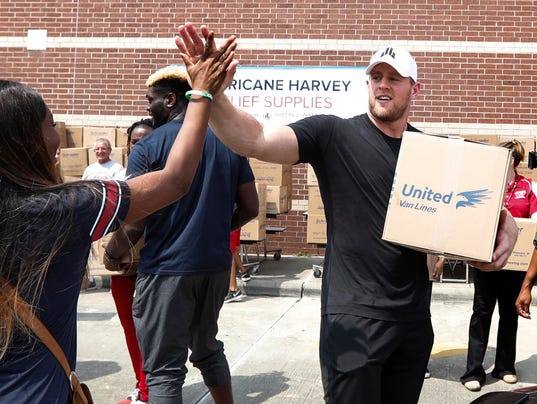
Bringing a Country Together: How J.J. Watt Helped Millions

Image result for jj watt harvey disaster relief fund
J.J. Watt handing out supplies - Credit: USA Today

The last time a major hurricane (category three or higher) made landfall in the United States was all the way back in 2005 when hurricanes Dennis, Wilma, Katrina, and Rita all caused extensive damage to Florida and Louisiana. It has been a record setting 12-year break before the next major hurricane made landfall in the United States: Hurricane Harvey, just three weeks ago.
Image may contain: outdoor and water
The extent of the flooding in Houston
Credit: Tri-State Weather

Hurricane Harvey developed in the western Gulf of Mexico in a matter of days, and set its sights on the United States' fourth largest city: Houston, Texas. Although Harvey made landfall about 150 miles southwest of Houston, some of the worst impacts of the storm were felt in the Houston metropolitan area, where places received upwards of 50 inches of rain in a matter of only five days. The flooding caused by Hurricane Harvey was catastrophic to the people of Houston, leaving millions without homes and stranded in shelters.

Any time that a natural disaster of this magnitude occurs, it is vital that others provide assistance to those impacted and help them to restore their lives back to normal. Often times you'll see national news stations give information as to how people can donate money to the Red Cross or other organizations that will provide aid for the victims of the natural disaster. 

Image result for jj watt
Houston Texans' J.J. Watt
Credit: Wikimedia Commons
But after Hurricane Harvey, starting defensive end for the Houston Texans, J.J. Watt, wanted to make an impact in his own way.

J.J. Watt started a crowdfunding campaign on youcaring.com shortly after Hurricane Harvey devastated the coast of Texas, and its monetary amount and popularity grew exponentially. Famous actors and well-known athletes contributed to Watt's relief fund, helping to bring its total-to-date to over $32 million, obliterating Watt's initial goal of $200,000. To no surprise, Watt's relief fund is now the fastest growing, largest crowdfunding charitable fundraiser in the ten-year history of crowdfunding.

Therefore, I am selecting J.J. Watt's Hurricane Harvey relief fund as my artifact, and I would most likely use some of the above facts and talking points to form a hook for my speech. Some talking points that might emerge in my speech could be how J.J. Watt made this crowdfunding campaign go viral and why so many people gave money to this relief fund.
Image result for youcaring logo

These talking points will allow me to discuss how J.J. Watt used the principles of rhetoric to convince famous athletes, celebrities, and the entire United States population to donate to his relief fund. These points will also allow me to talk about how Watt's crowdfunding campaign invited the general public to be civic and help those impacted by Hurricane Harvey by donating money. 

I believe that this artifact will allow me to develop a well-crafted speech that will be engaging for the audience to listen to.

Wednesday, September 6, 2017

A World of Weather vs. Sports News Now

Choosing a topic to write about for my passion blog has been difficult, but not in the way that you may think.

Many people struggle with coming up with ideas in the first place. But for me, it was the complete opposite.

A jumble of ideas wandered through my mind, and I could envision each one of these ideas turning into an amazing and successful passion blog. For me, the difficulty was narrowing down my ideas from dozens to just two. I don't know if that's because of my wide variety of interests or if it's just because I enjoy researching and writing about things that I like. In any case, here are the two passion blog topics that I'm most interested in writing about over the course of this semester:

Hurricane Isabel - Credit: NASA  

As a meteorology major, I obviously love the weather - some may call me a "weather weenie." I've wanted to become a meteorologist since I was seven, so I've been fascinated by severe weather events and about weather predictions for a long time.

Credit: NOAA Photo Library
It's also clear that the weather changes constantly. Everyone probably checks the weather at least once a day, for instance, to see what to wear that day, if it's a good idea to bring an umbrella with them, or if classes will be canceled because of snow. Weather impacts our daily lives, and something interesting is happening with the weather every day.

GOES Floater Rainbow IR (Irma) -
Credit: Wiki Commons
Take the past few weeks for example. We've seen the strongest hurricane to make landfall since 2005 destroy the Texas coast and we have another monster hurricane ready to strike Florida over the weekend. The weather headlines never stop, so I believe that "A World of Weather" would be a great passion blog for me to write about.

I'm also a huge sports fan in my free time, paying particular attention to baseball, football, college football, hockey, and college basketball. Similar to the weather, there's always some new major development in the sports world on a daily basis.

Credit: Annemarie Mountz
Whether it's players getting injured, an impressive performance by a particular athlete, or even an upset that no one saw coming, there will always be something new and interesting to talk about in the world of sports. This semester encompasses the MLB playoffs and a good majority of both the college football and NFL regular seasons, which would ensure that I would have plenty to write about in my blog "Sports News Now."

Now I must narrow my ideas down even further: from two to one. And this will be the most difficult decision yet.